


Douleur de hanche la nuit : pourquoi dormir sur le côté l'aggrave
Vous vous couchez fatiguée, prête à dormir, et là, une gêne sourde s'installe sur le côté de la hanche. Vous changez de position, vous y revenez, et la douleur vous réveille au milieu de la nuit. Si dormir sur le côté est devenu un petit calvaire, vous n'êtes pas seule. Cette douleur a souvent une explication mécanique simple, et surtout, des solutions douces existent. On vous explique tout, calmement.
Pourquoi la hanche fait-elle plus mal la nuit ?
Le jour, vous bougez. Vous marchez, vous vous levez, vous changez de posture sans même y penser. Ces micro-mouvements répartissent la pression et laissent peu de temps à une zone précise pour s'irriter.
La nuit, c'est l'inverse. Quand vous dormez sur le côté, la face externe de votre hanche devient un point d'appui entre votre corps et le matelas. Des heures durant, tout le poids de cette partie du corps se concentre au même endroit. Si cette zone est déjà un peu irritée, des heures de pression peuvent suffire à réveiller la douleur.
C'est pour cela qu'une douleur discrète en journée peut devenir franchement gênante une fois allongée.
La fameuse bursite de la hanche
Sur le côté de votre hanche, il existe un petit coussin naturel rempli de liquide, appelé bourse séreuse. Son rôle est de réduire les frottements entre l'os, les muscles et les tendons. Imaginez un mini airbag protecteur, niché contre la partie saillante de l'os de la hanche.
Quand cette bourse s'irrite, par compression répétée ou frottement, elle gonfle et devient sensible. On parle alors de bursite. La douleur se manifeste sur le côté de la hanche, souvent accompagnée d'une sensibilité au toucher, et peut vous réveiller la nuit, particulièrement lorsque vous dormez sur le côté affecté.
Détail surprenant : vous pouvez avoir mal des deux côtés au réveil, même si vous n'avez dormi que sur un seul. C'est l'un des signes les plus courants chez les personnes qui dorment sur le côté.
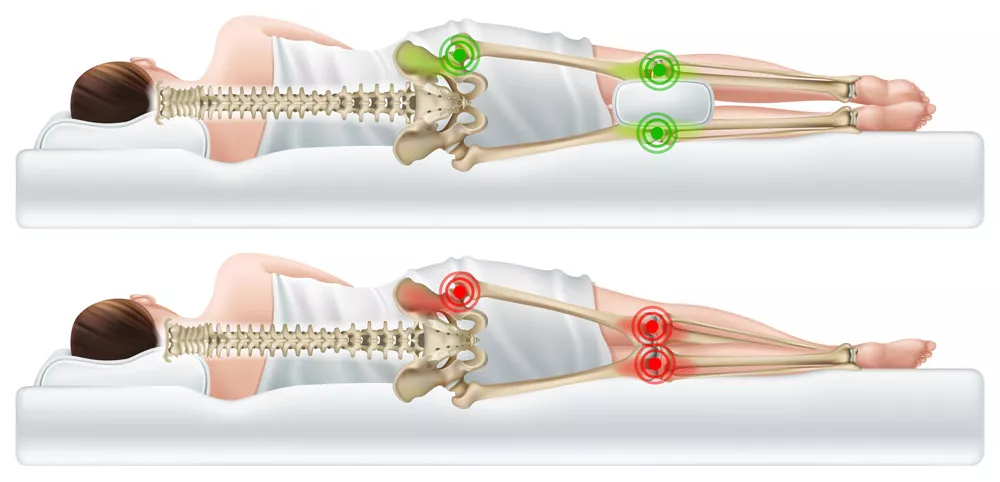
Quand la jambe du dessus bascule vers l'avant
Il y a un autre mécanisme, plus discret, qui entretient l'inconfort. Quand vous dormez sur le côté sans rien entre les genoux, la jambe du dessus a tendance à glisser vers l'avant. Ce mouvement entraîne une rotation du bassin, qui se répercute jusque dans le bas du dos.
Résultat : votre hanche reste tordue plusieurs heures, vos muscles tirent d'un côté, et la pression se concentre là où ça fait déjà mal. Maintenir les genoux dans le même axe change beaucoup de choses, et c'est précisément là qu'un soutien entre les jambes entre en jeu.
Quelques gestes simples pour des nuits plus douces
Avant tout, écoutez votre corps. Si une hanche est nettement plus douloureuse, essayez de lui accorder du repos en dormant sur le côté opposé ou sur le dos, ce qui peut suffire à réduire l'irritation nocturne.
Voici d'autres pistes faciles à tester :
- Glissez un coussin ferme entre vos genoux pour garder les hanches alignées.
- Vérifiez la fermeté de votre matelas. Un matelas qui laisse la hanche s'enfoncer trop profondément concentre la pression.
- Évitez de croiser les jambes en journée, ce geste sollicite la zone.
- Pliez légèrement les genoux pour relâcher le bas du corps.
Ces ajustements ne remplacent pas un avis professionnel, mais ils rendent souvent les nuits plus supportables.
Le coussin Pillova, un allié simple entre vos genoux
Parmi ces solutions, le coussin d'alignement Pillova répond directement au problème de la jambe qui bascule. Glissé entre les genoux, il garde vos jambes parallèles et votre bassin dans une position neutre, ce qui limite la torsion de la hanche pendant la nuit.
Sa mousse à mémoire de forme à densité contrôlée ne s'affaisse pas sous le poids des jambes, contrairement à un oreiller classique qui s'écrase en une heure. Sa sangle réglable le maintient en place, même si vous bougez beaucoup. Et sa housse déhoussable se lave en machine, un vrai plus pour la transpiration nocturne.
C'est un accessoire de bien-être, pas un dispositif médical. Il ne soigne pas une bursite, mais il aide à soulager la pression et à rendre la position sur le côté plus confortable. Avec 45 nuits d'essai satisfaite ou remboursée, vous avez le temps de voir s'il change vos nuits.
En cas de douleur persistante
Si la douleur dure, s'intensifie, vous réveille chaque nuit ou s'accompagne d'un blocage ou d'une instabilité, parlez-en à un professionnel de santé. Lui seul peut poser un diagnostic et vous orienter vers une prise en charge adaptée, comme de la kinésithérapie. Un accessoire de confort complète ce suivi, il ne le remplace jamais.


