


Nighttime hip pain: why sleeping on your side makes it worse
You go to bed tired, ready to sleep, and then a dull discomfort settles on the side of your hip. You change position, you come back to it, and the pain wakes you up in the middle of the night. If sleeping on your side has become a small ordeal, you're not alone. This pain often has a simple mechanical explanation, and above all, gentle solutions exist. We'll explain everything, calmly.
Why does the hip hurt more at night?
During the day, you move. You walk, you get up, you change posture without even thinking about it. These micro-movements distribute pressure and leave little time for a specific area to become irritated.
At night, it's the opposite. When you sleep on your side, the outer side of your hip becomes a pressure point between your body and the mattress. For hours on end, all the weight of this part of the body concentrates in the same place. If this area is already a bit irritated, hours of pressure can be enough to awaken the pain.
That's why a discreet pain during the day can become frankly bothersome once you're lying down.
The well-known hip bursitis
On the side of your hip, there is a small natural cushion filled with fluid, called a bursa. Its role is to reduce friction between the bone, muscles and tendons. Imagine a mini protective airbag, nestled against the protruding part of the hip bone.
When this bursa becomes irritated, through repeated compression or friction, it swells and becomes sensitive. This is called bursitis. The pain manifests on the side of the hip, often accompanied by tenderness to the touch, and can wake you up at night, particularly when you sleep on the affected side.
Surprising detail: you can have pain on both sides upon waking, even if you only slept on one. It's one of the most common signs among people who sleep on their side.
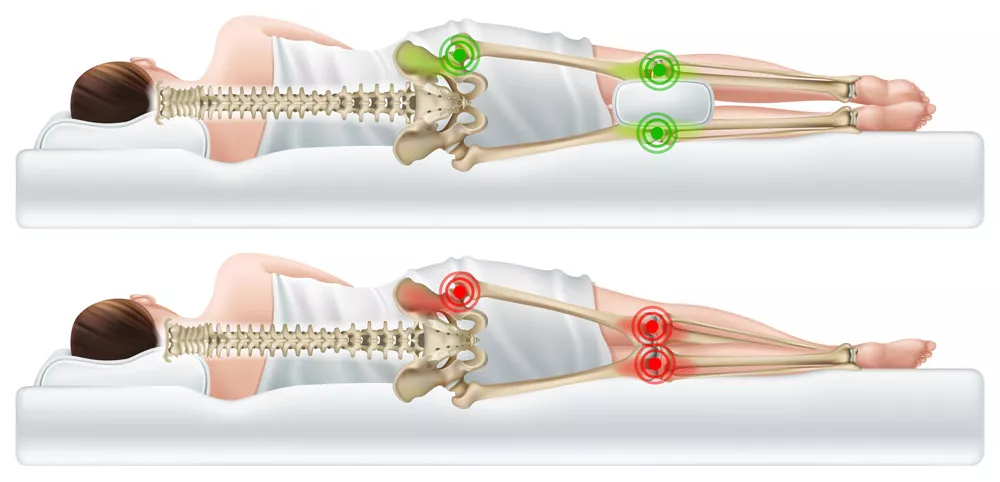
When the top leg tips forward
There is another mechanism, more subtle, that maintains the discomfort. When you sleep on your side with nothing between your knees, the top leg tends to slide forward. This movement causes a rotation of the pelvis, which echoes down to the lower back.
Result: your hip remains twisted for several hours, your muscles pull to one side, and pressure concentrates where it already hurts. Keeping the knees in the same axis changes many things, and that's precisely where support between the legs comes into play.
A few simple actions for gentler nights
Above all, listen to your body. If one hip is noticeably more painful, try to give it some rest by sleeping on the opposite side or on your back, which may be enough to reduce nighttime irritation.
Here are other easy options to try:
-
Slip a firm cushion between your knees to keep the hips aligned.
-
Check the firmness of your mattress. A mattress that lets the hip sink too deeply concentrates pressure.
-
Avoid crossing your legs during the day, this gesture strains the area.
-
Bend your knees slightly to release the lower body.
These adjustments don't replace professional advice, but they often make nights more bearable.
The Pillova cushion, a simple ally between your knees
Among these solutions, the Pillova alignment cushion directly addresses the problem of the leg tipping over. Slipped between the knees, it keeps your legs parallel and your pelvis in a neutral position, which limits the twisting of the hip during the night.
Its memory foam with controlled density doesn't sag under the weight of the legs, unlike a classic pillow that flattens within an hour. Its adjustable strap holds it in place, even if you move a lot. And its removable cover is machine washable, a real plus for nighttime perspiration.
It's a wellness accessory, not a medical device. It doesn't cure bursitis, but it helps relieve pressure and make the side-sleeping position more comfortable. With 45 satisfied-or-refunded trial nights, you have time to see if it changes your nights.
In case of persistent pain
If the pain lasts, intensifies, wakes you every night or is accompanied by blockage or instability, speak to a healthcare professional. Only they can make a diagnosis and direct you to suitable care, such as physiotherapy. A comfort accessory complements this follow-up, it never replaces it.


